Procedure
Submit a CycloneDX document and obtain a traceable policy decision
Prepare an API token and project scope, submit with Kubaba CLI, wait for asynchronous evaluation, and verify the PASS/WARN/BLOCK result.
Role and prerequisites
The token owner must retain CreateScan, UploadSbom, and ViewScan; add RunScanReevaluation when needed and CreateScanProject only for the explicit project-creation flow.
- OSV bootstrap must be successful and the target organization/project active.
- CycloneDX JSON must be version 1.5 or newer, and the client must reach the backend with TLS verification.
- The token is shown only once; store it in a CI secret manager and provide it through KUBABA_TOKEN.
Procedure steps
- Create a token with the narrowest required scopes on API Tokens, store the complete value securely, and confirm it cannot be recovered after closing the creation dialog.
- Use kubaba config set to persist only non-secret settings such as server, project, organization, timeout, and output; confirm kubaba config view never prints token material.
- Run kubaba sbom scan <file> for an existing SBOM or kubaba audit <path> for a source tree. If an absent project must be created explicitly, use --create-project with a project key.
- Observe the CLI creating the scan, streaming the SBOM with a checksum, waiting for terminal state after completion, and reading the latest policy result.
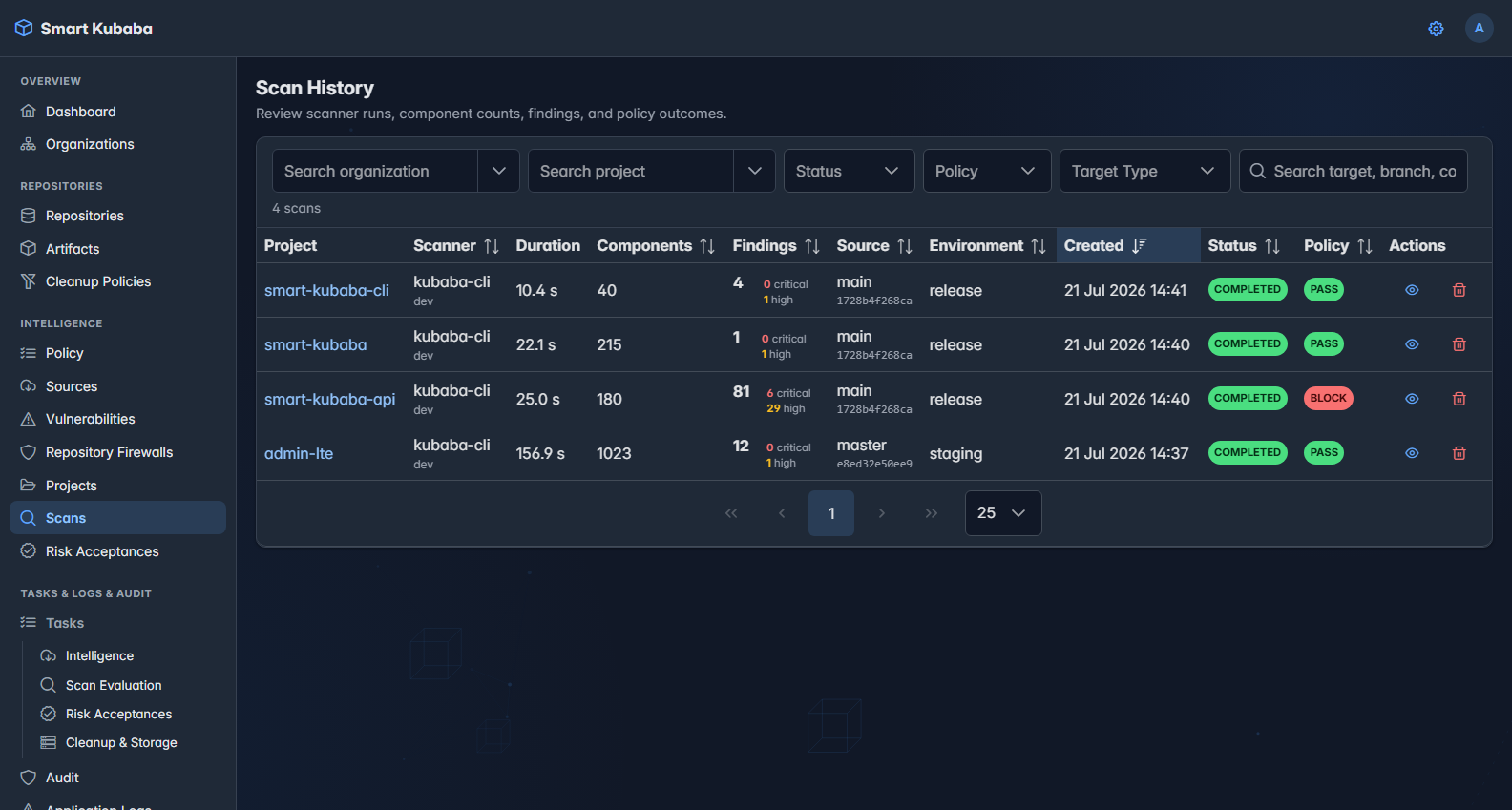
- In Scans > detail, verify Overview, Components, Dependencies, Findings, Policy, and SBOM tabs, plus environment, branch, commit, and unresolved counts.
Success criteria
- The scan reaches Completed; raw SBOM checksum and size metadata are visible without exposing the storage key.
- Components and dependency edges are paginated, and findings link to OSV advisory and fixed-version evidence.
- Without unresolved components, applicable policies produce PASS, WARN, or BLOCK; BLOCK maps to CLI exit code 1, while WARN fails only with fail-on-policy.
- Re-uploading the same checksum to the same scan is idempotent as a duplicate, and repeated completion does not create another initial job.
Failure and security boundaries
- An invalid bearer token never falls back to a browser session and is rejected with 401. Tokens are not written to logs, URLs, config files, or child-process environments.
- Malformed, checksum-mismatched, unsupported, or oversized SBOMs are rejected and temporary storage objects are cleaned up.
- Unsupported ecosystems, invalid versions, or unresolved ranges appear as NOT_EVALUATED and are not treated as vulnerability-free.
- --create-project never silently changes an existing organization, populated branch or repository URL, or inactive project.