Procedure
Govern artifact retention with dry-run, execution, and restore evidence
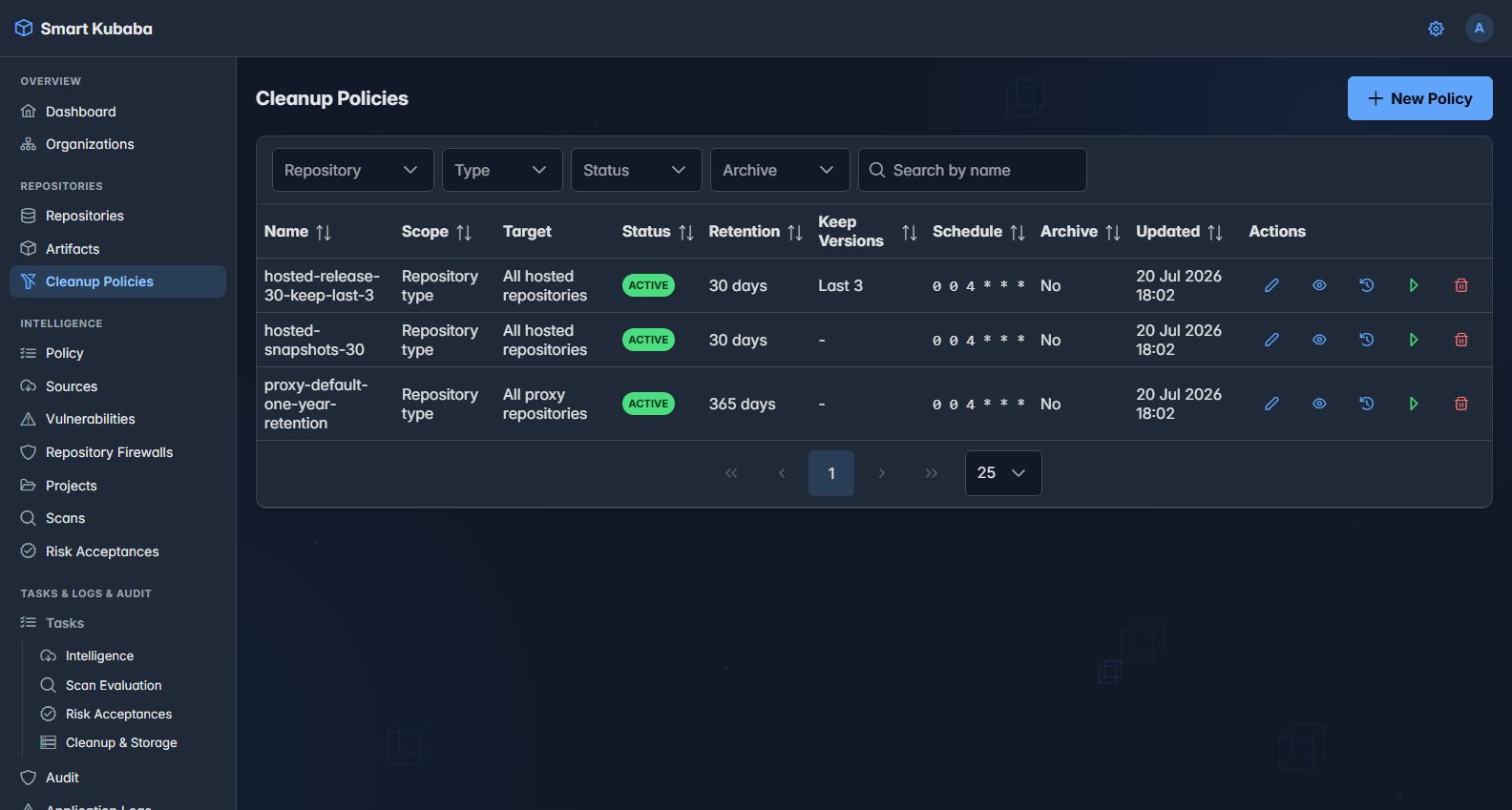
Apply repository scope, retention, pattern, keep-last, schedule, and archive-on-delete rules in a controlled cleanup flow.
Role and prerequisites
Creating or changing policy requires ManageCleanupPolicy; dry-run or execution requires RunCleanup.
- A policy must select exactly one scope: all repositories, one repository, or Hosted, Proxy, or Group type.
- At least one of retentionDays, matchPattern, or keepLastVersions is required; archiveTarget is mandatory when archiving is enabled.
- Record a test package in advance to verify checksum, usage, and restoration evidence.
Procedure steps
- In Cleanup Policies, enter scope, retention, keep-last, match/exclude, schedule, and archive settings; inspect the Affected Repositories preview.
- Run the supported dry-run API; after completion, compare candidateCount and target samples with policy expectations. Dry-run must not change storage or metadata.
- If scope is correct, confirm Run now. Verify only one PENDING or RUNNING run exists for the policy.
- On Tasks > Cleanup & Storage, monitor processed, deleted metadata and storage, archived, and failed counters.
- With archiving off, metadata must be DELETED and the active object removed; with archiving on, metadata must be ARCHIVED and the object moved to the archive namespace.
- To validate restoration, supply the same package again through the normal publish or upload path; after permission, format, checksum, and overwrite checks, confirm it is ACTIVE with RESTORED evidence.
Success criteria
- The run reaches COMPLETED and candidateCount, processedCount, and result counters are consistent.
- Each processed artifact has a cleanup_run_item and a CLEANUP_DELETE or CLEANUP_ARCHIVE lifecycle record.
- CLEANUP_RUN_STARTED or COMPLETED audit and CLEANUP operation logs are linked by job id.
- If node loss is tested, the cursor and PostgreSQL lease allow another replica to continue remaining work.
Failure and security boundaries
- A disabled policy and a second concurrent run are rejected; the one-active-run rule is also enforced by the database.
- An item failure does not stop the entire run; the failure is recorded and the artifact keeps its prior state.
- Archived objects are not served from active package endpoints; merely existing in the archive location does not reactivate metadata.
- Do not start a broad-scope real run until SQL LIKE patterns and keep-last behavior are validated with sample data.